Germany is closing Europe’s biggest coal pit. The hard part starts after the coal.
Hambach stops producing lignite in 2029. It leaves behind a 40 year bet on Rhine water, ground that keeps moving beyond the fence, and a coal reserve decision Berlin has already postponed. An environmental intelligence specialist checked the operator’s story at the rim against the record.
By Kisife Fomotar Jude · 14 October 2026 · Hambach open pit mine, Elsdorf, North Rhine Westphalia · Site visit 10 October 2026
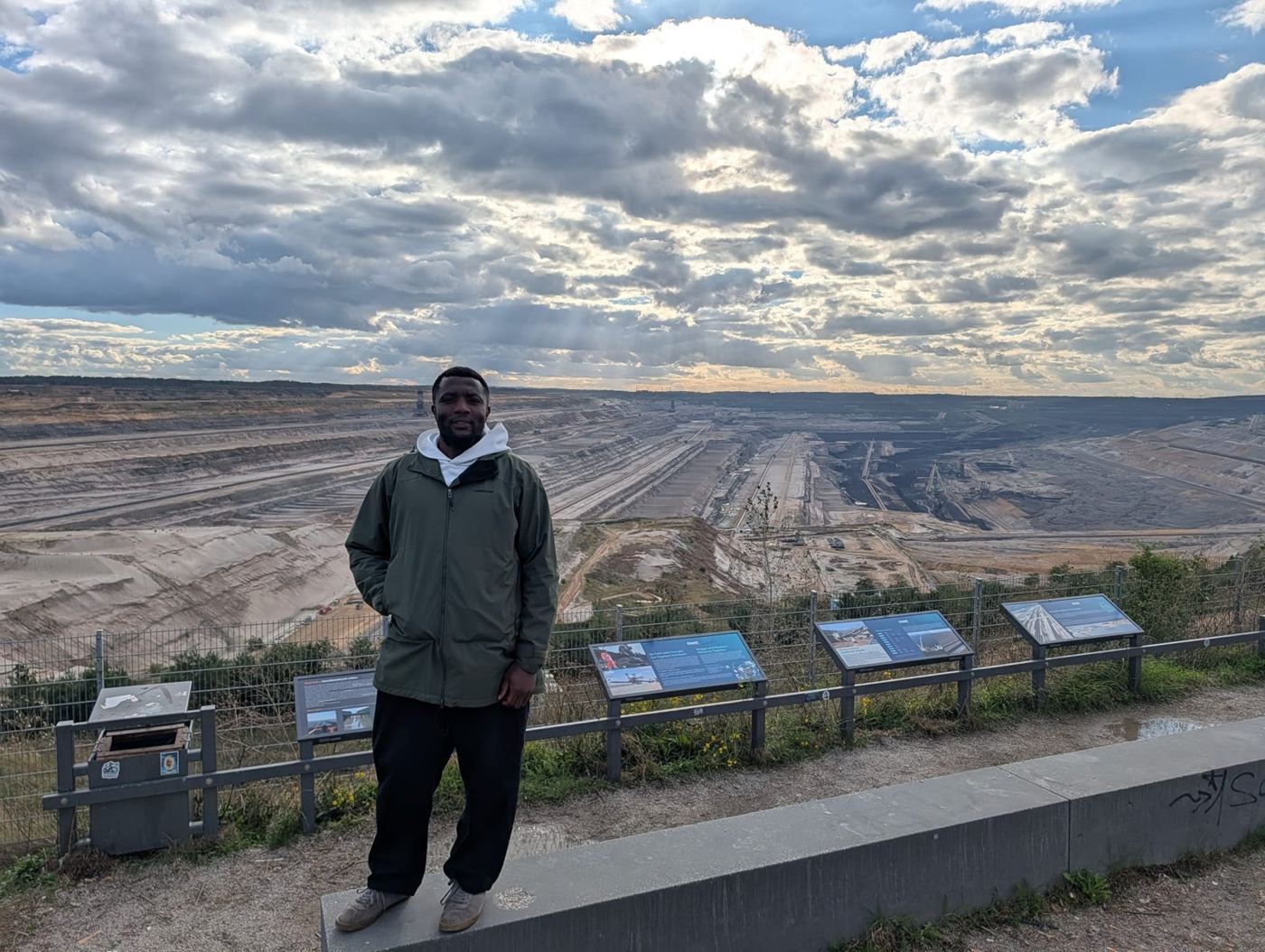
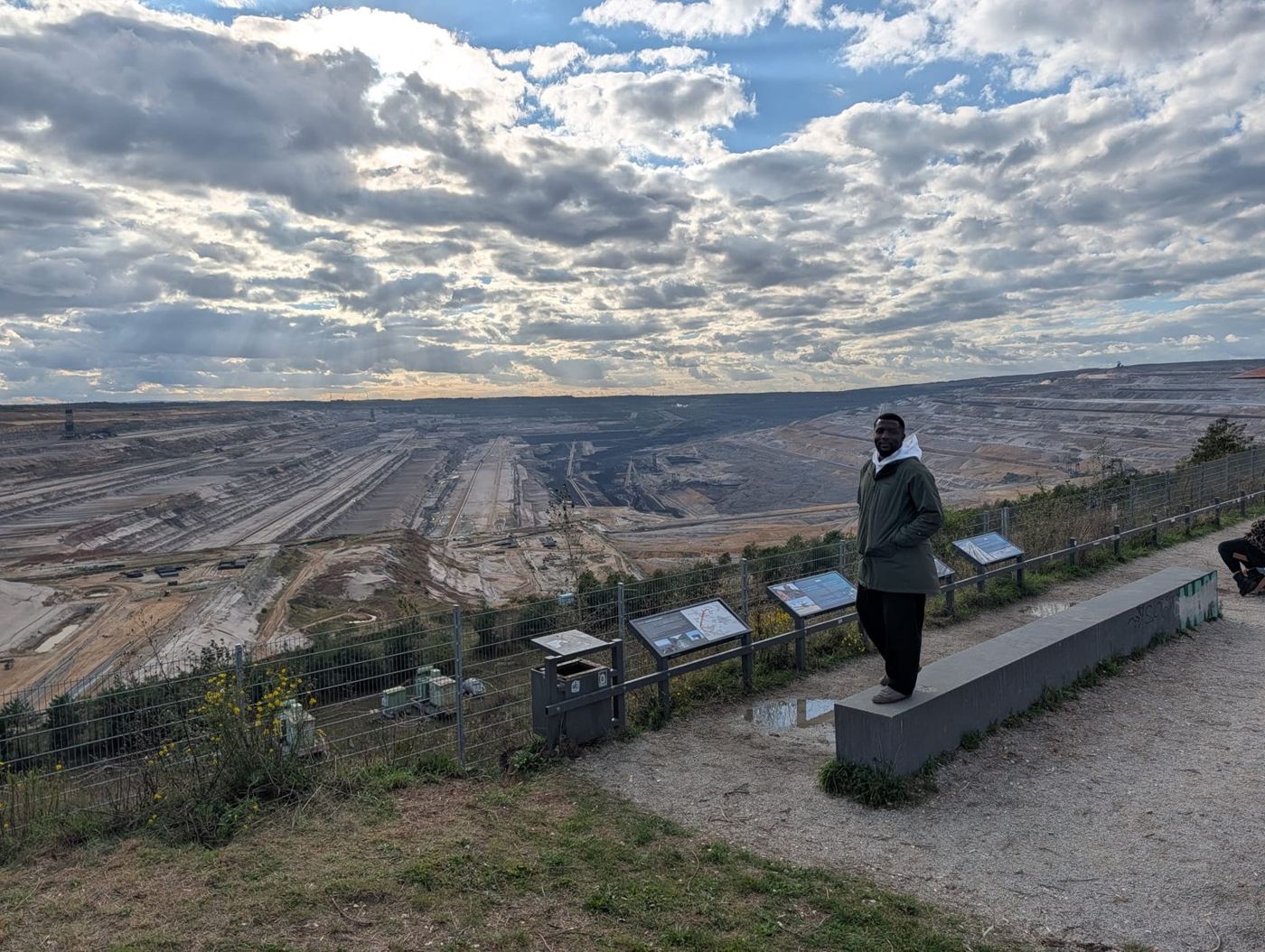
On a Saturday afternoon in October, the viewpoint at Forum terra nova in Elsdorf looks like a seaside promenade without the sea. Visitors sit in red wooden deckchairs. A child’s wagon stands loaded with bags and a pink toy. Beyond the fence, the Hambach open pit mine falls away in grey and ochre terraces toward a coal seam that the panels place at about 400 metres down [1]. One bucket wheel excavator moves on the far bench, small enough to cover with a thumb.
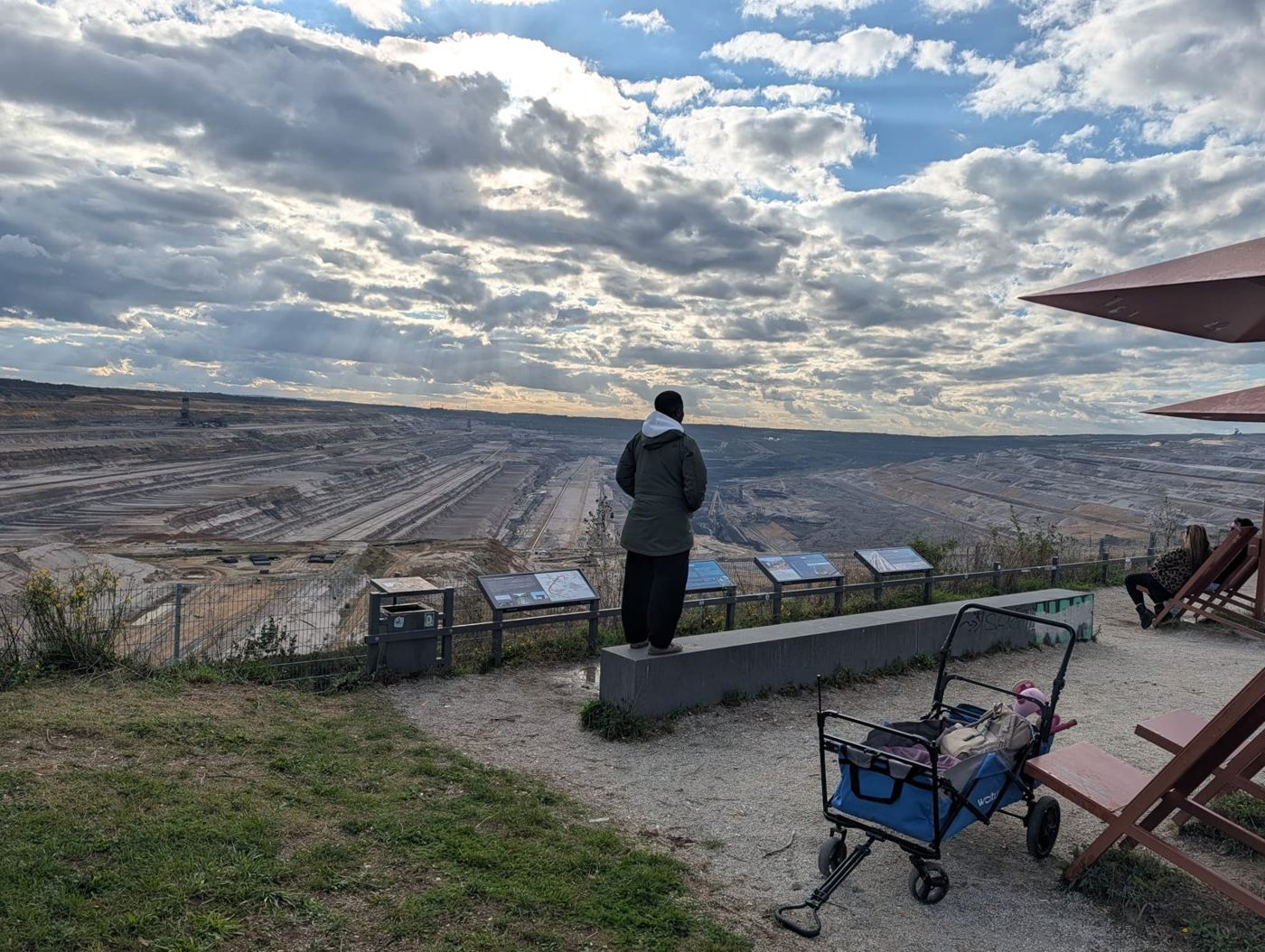
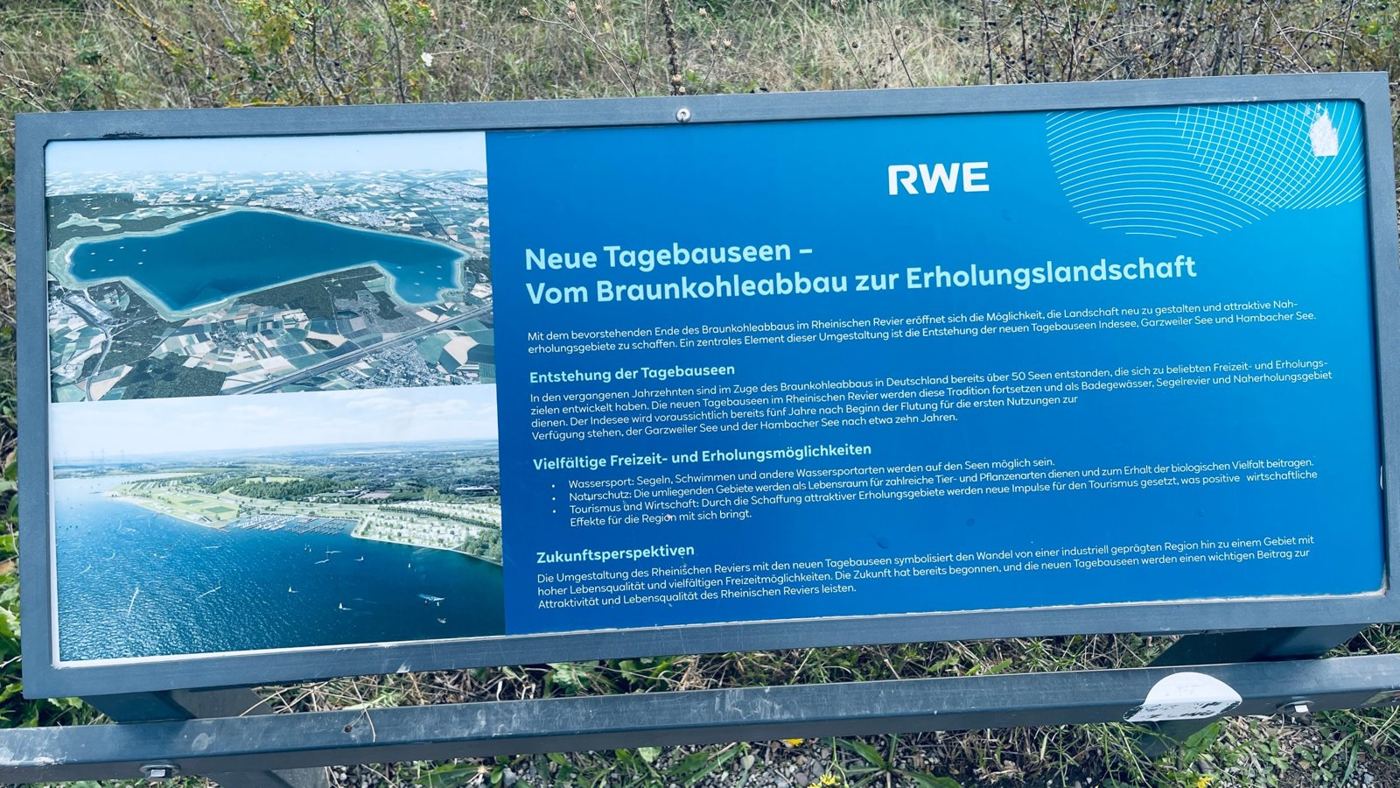
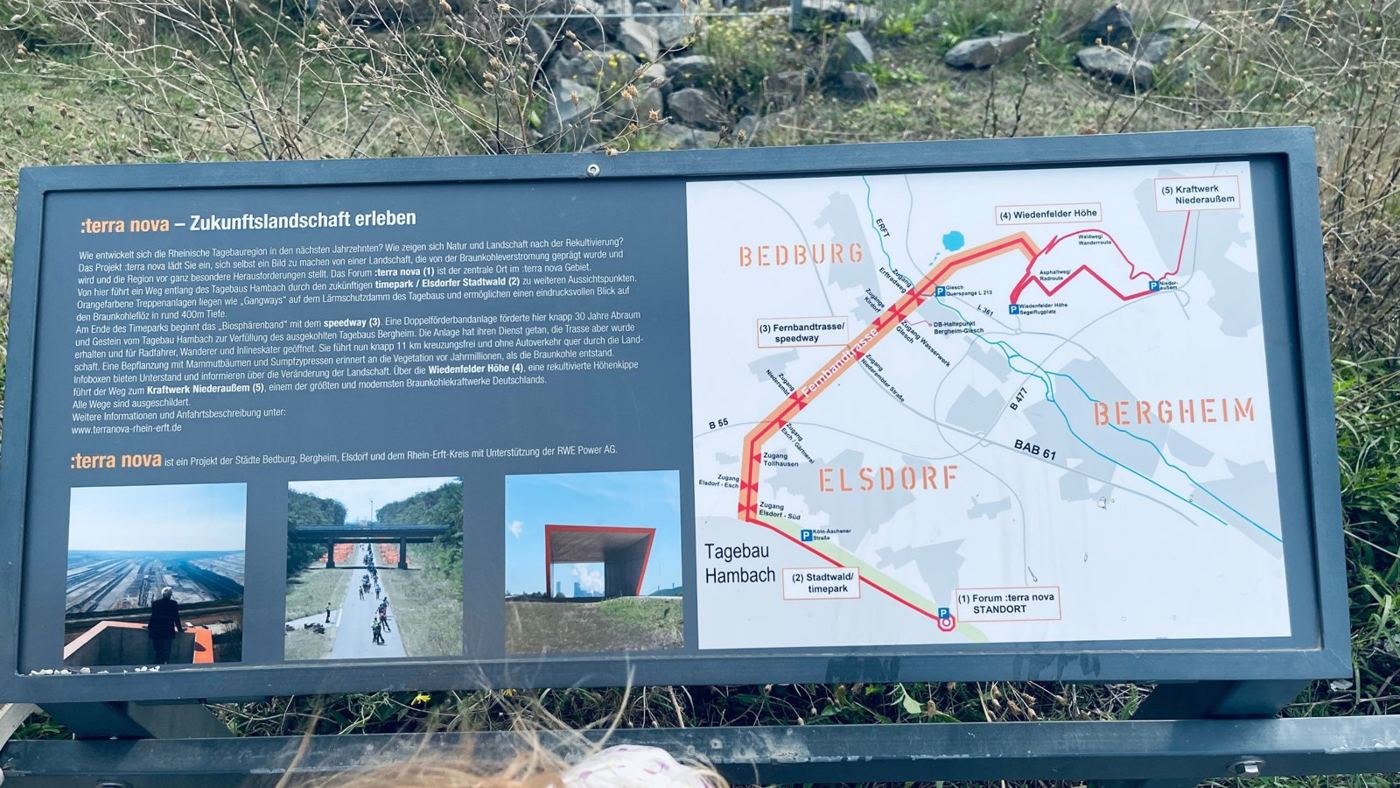
Eight information panels line that fence. Seven carry the RWE logo. The eighth belongs to terra nova, a project of the towns of Bedburg, Bergheim and Elsdorf and the Rhein Erft district. Together they tell a clean story: coal ends, Rhine water arrives, a lake district follows. One panel promises that the future Hambacher See will be open for its first uses after about ten years of flooding [1].
I spend my working life checking official maps against the ground, mostly in Central African forests, where a satellite polygon and a field plot often disagree. At Hambach I read every panel. Then I checked each claim against permits, federal law, court rulings, monitoring reports and the peer reviewed literature.
My conclusion is narrower, and more uncomfortable, than either side of Germany’s coal debate tends to admit. Whether Hambach should close is settled. What its closure will cost, who will pay, and who will check, is not. On three fronts, water, ground and carbon, the public is being asked to trust the operator’s timetable at the moment the evidence says that timetable is uncertain.
The coal decision is made. The water decision is not.
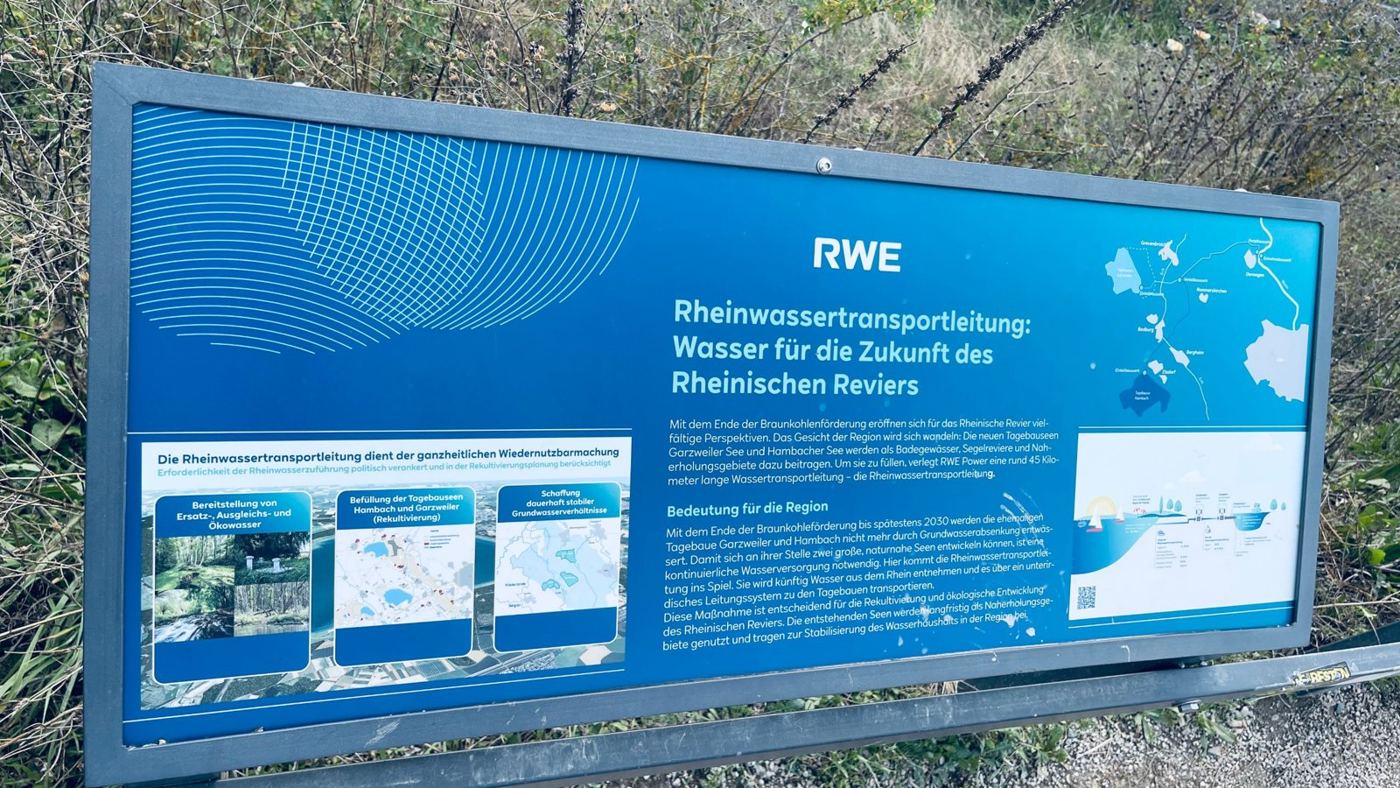
For almost five decades Hambach has stayed dry because RWE pumps out the groundwater. Across its Rhenish mines the company reports mine drainage of 520 million cubic metres a year [2]. The panel on Rhine water states the consequence: once extraction ends, the pits will no longer be drained, and two large lakes can only form with a continuous outside supply of water [1].
That supply is a 45 kilometre steel pipeline from Dormagen on the Rhine, approved by the mining authority in January 2026 and under construction since March [3] [4]. From 2030 a pumping station is planned to lift up to 18 cubic metres of Rhine water a second by about 110 metres and send it to Hambach. Garzweiler follows in 2036 [4] [5]. Planning figures describe a lake of about 3,600 hectares and up to 325 metres deep, which would make it the deepest lake in Germany [5]. Filling is expected to take around 40 years [5], with completion reported near 2070 [6].
Filling a pit with river water is sound practice, and the evidence for it is good. In the Central German lignite district, Lake Goitsche was filled with water from the river Mulde between 1999 and 2002. The river water neutralised the acidity that forms when pyrite in drained mine spoil oxidises [7]. Schultze and colleagues describe river water filling as effective and economical, and name its main limit: whether enough water is available [7]. At Hambach, that limit is the problem.
The Rhine is becoming less reliable in summer. The International Commission for the Protection of the Rhine projects that summer low flow at Cologne, measured as the lowest seven day mean, will change by between -34 % and +1 % in 2031 to 2060 relative to 1981 to 2010, with the core of the scenarios between -22 % and -3 %. For 2071 to 2100 the range widens to -53 % to -6 % [8]. Hambach’s filling period sits inside those decades. RWE reduces abstraction when the river runs low [5]. That protects shipping and river ecology, and it stretches the schedule. A panel that promises first use after ten years of a filling planned to take forty is describing the optimistic edge of a range.
Water quality is the second half of the problem. No treatment plant is planned for the Hambach transfer [9]. Research on the lower Rhine shows why that matters. Albergamo and colleagues screened bank filtrate fed by the Lek, a Rhine distributary in the Netherlands, detected more than 18,000 chemical profiles, and found that polar micropollutants can persist and migrate underground for decades [10]. A 325 metre lake in contact with aquifers that supply drinking water is a different receptor from a flowing river. CORRECTIV reported in February 2026 that critics fear river contaminants could seep from the new lakes into groundwater and wells, and that low flows concentrate them [11]. RWE says the Rhine water is suitable. The conservation groups BUND, NABU and LNU accept that no realistic alternative source exists, but want the water treated first [11].
Two formal questions remain open. The pipeline is permitted, but the water law permit to create, fill and operate the lakes is not yet settled. BUND calls the step by step approval “salami tactics” [12]. And a legal opinion commissioned by BUND argues that RWE owes the state’s water abstraction fee on the Rhine water, which RWE disputes [9].
The pit does not stop at the fence
Draining a basin for half a century moves more than water. Researchers at the GFZ Helmholtz Centre for Geosciences used Sentinel 1 radar data from the European Ground Motion Service to map land subsidence around the Rhenish mines. They found that it extends well beyond the pit edges. Distance to the mine was the strongest predictor of subsidence, followed by change in groundwater level. The drainage also slowly reactivates old faults, leaving steps in the ground and damage to roads and houses [13]. When the pumps stop and groundwater returns, the stresses on that ground change again.
This is the strongest argument for RWE’s current work, and it deserves a fair hearing. On 18 July 2009 at Nachterstedt in Saxony Anhalt, a slope on the shore of Concordia See, a lake in a former mining area, failed and slid into the water. Three people died and buildings were destroyed. Groundwater standing high against the lake level was a cause [14]. A lake 325 metres deep needs flat, stable slopes, and building them takes material. That is why RWE still digs in the Manheimer Bucht south of the pit, where BUND reports 216 hectares being excavated to about 60 metres for slope material, not coal [15]. It is also why the Higher Administrative Court in Münster allowed RWE to clear the Sündenwäldchen woodland in January 2025 [16].
The fair conclusion is not that the digging is wrong. It is that outsiders cannot judge whether it is the minimum needed. The slope design, the material balance and the alternatives are not presented at the site, or in RWE’s public summaries, in a form anyone can check. The panels at the viewpoint do not mention the Manheimer Bucht at all.
The carbon question Berlin postponed
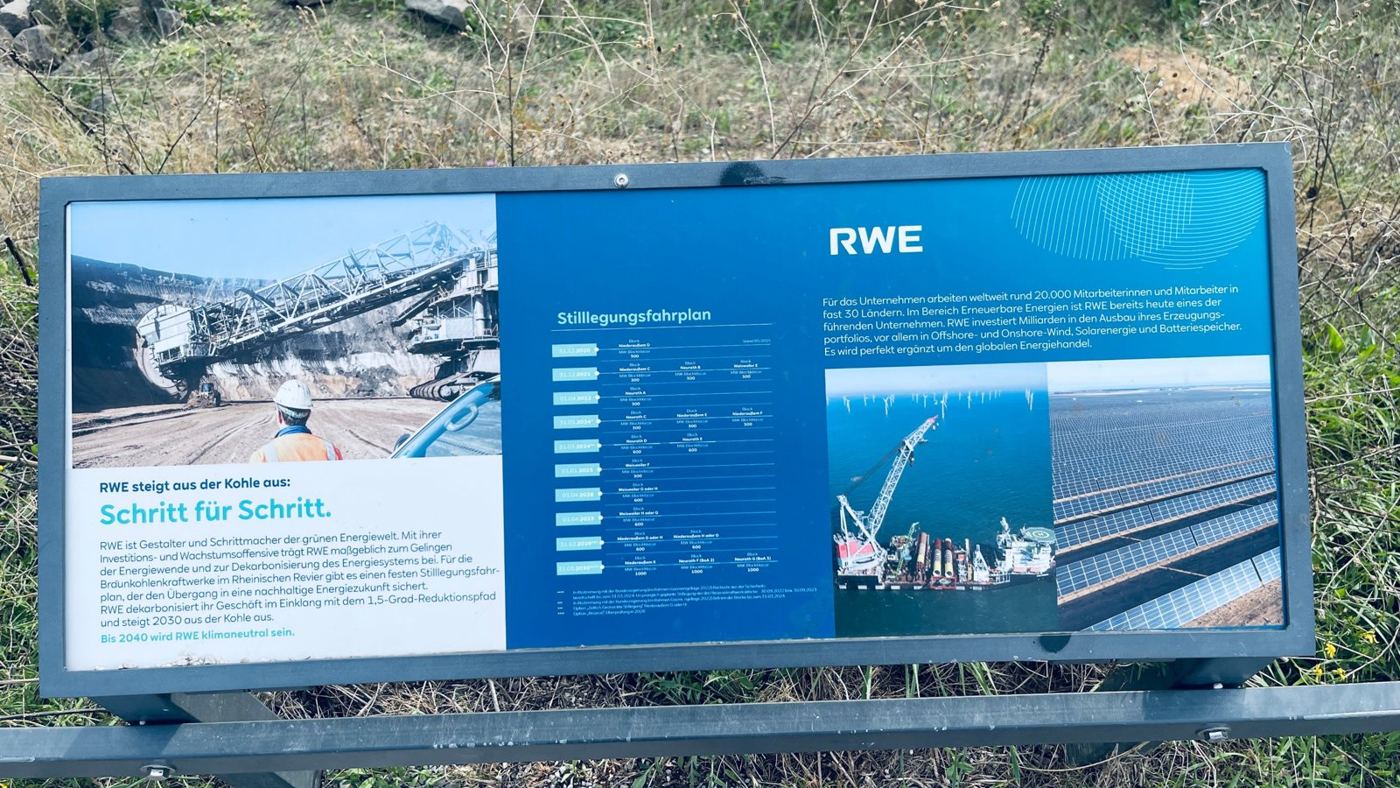
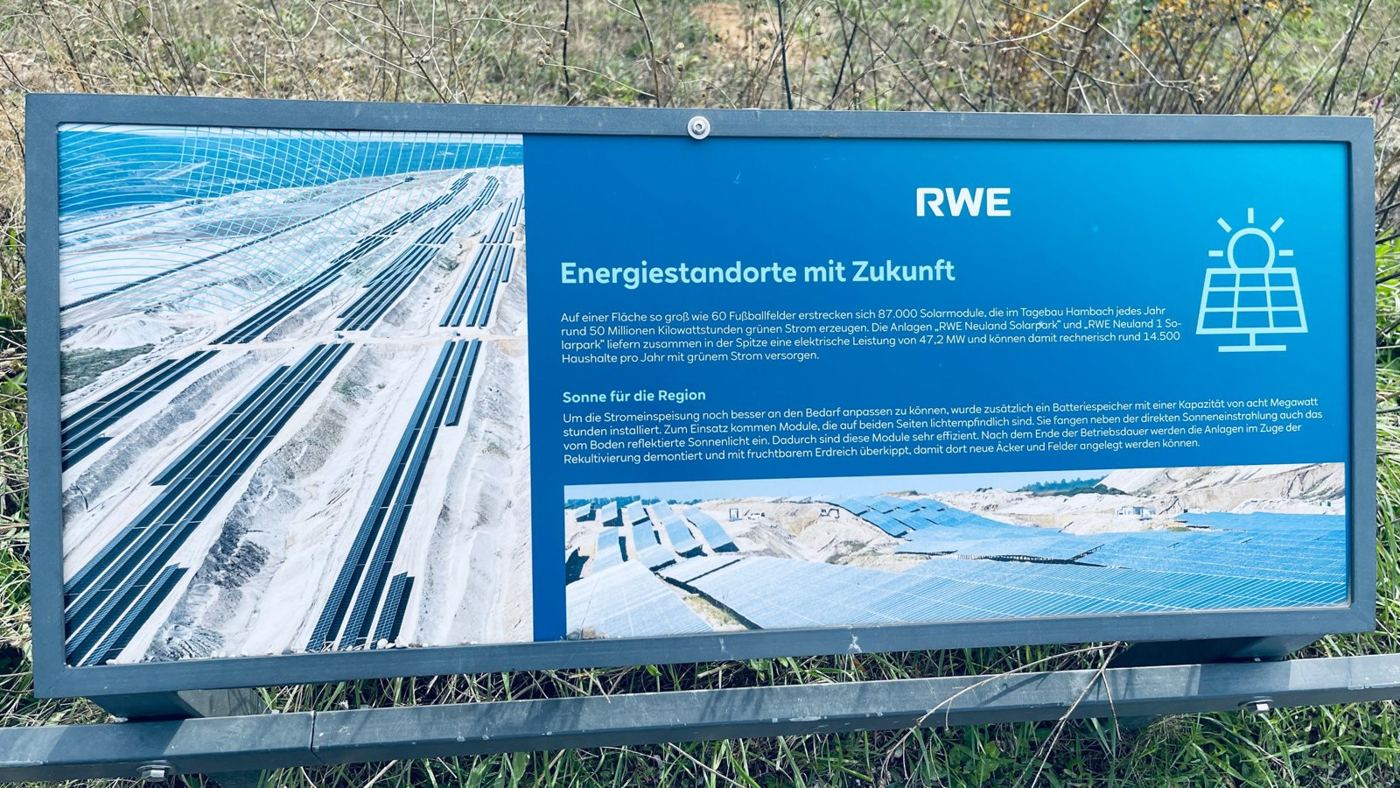
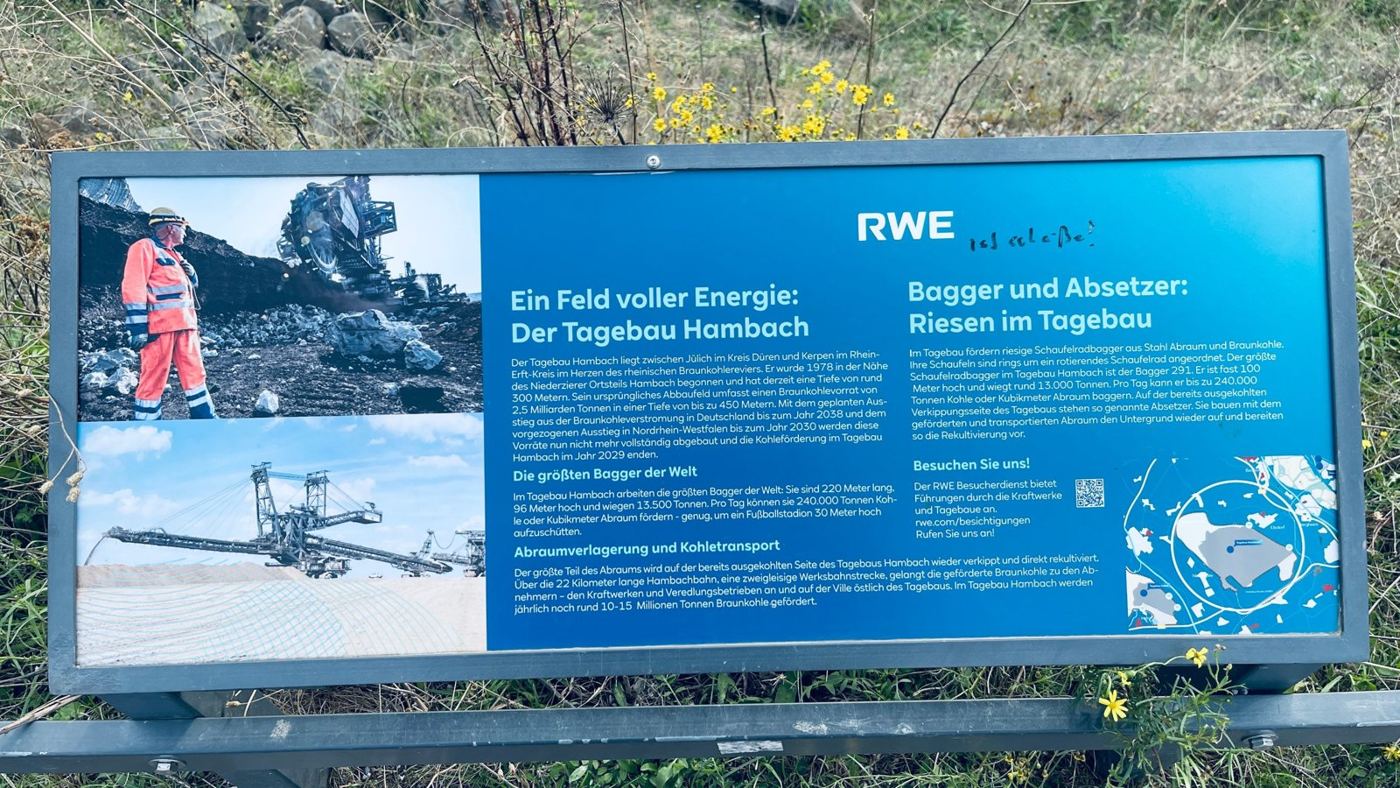
Coal is still coming out. RWE’s own panel gives Hambach’s output as 10 to 15 million tonnes of lignite a year [1], carried by rail to power stations that rank among the most polluting in Europe. In 2018, EU emissions trading data placed Neurath second and Niederaußem third among the Union’s largest emitting installations, at 32.2 and 25.9 million tonnes of CO2 [17]. The remaining units emit between 1,092 and 1,188 grams of CO2 per kilowatt hour [18]. None of these numbers appears on the panels, which report the solar park inside the pit in megawatts and households.
The law already contains a decision point. Under §47(4) of the Coal Phase out Act (KVBG), the federal government had to assess by 15 August 2026 whether the last three Rhenish units, Niederaußem K and Neurath F and G, about 3 gigawatts in total, should move into a reserve on 1 April 2030 and stay there until 31 December 2033 at the latest [19] [20]. The Federal Ministry for Economic Affairs and Energy missed the date. It says it will wait for this year’s auctions for about 11 gigawatts of new gas fired capacity, due online by the end of 2031, so that its supply security analysis is “realistic and robust” [21]. RWE’s chief executive, Markus Krebber, says the company is still planning for 31 March 2030: “We have a clear contract, a clear law” [22].
The case for the reserve is real. German households paid an average of 37.97 cents per kilowatt hour for electricity in the first half of 2026, and their gas cost 80.7 % more than in the second half of 2021. dpa reports that companies are already feeling gas price pressure from the Hormuz crisis [23]. If coal leaves in March 2030 and replacement gas arrives as late as 2031, a gap opens. The SPD’s lead candidate for the 2027 state election calls the early exit a mistake [24], and the mayor of neighbouring Rommerskirchen wants the reserve used until 2033 [18].
The case against is also on the record. A Bundesnetzagentur supply security monitoring report found electricity supply secure from 2025 to 2031 even with a full coal exit in 2030 [25]. RWE says its first new gas plants could be ready in 2029 [22]. And a reserve keeps the units off the market: they run only when called [18].
My view is that the reserve is defensible as insurance. What is not defensible is deciding it without the rules. How a reserve would be dispatched, who pays for it, and how its emissions count against Germany’s climate targets are still not written into federal law, according to the North Rhine Westphalia economics ministry [18]. A policy with no terms is not insurance.
Who the transition is for
The villages lost here are not hypothetical. Lich Steinstraß was demolished in 1989 and Etzweiler in 2005 [26]. Manheim was resettled and stands largely empty. Morschenich was spared late and renamed Bürgewald. The old Bürgewald forest, of which the Hambach Forest is the remnant, has shrunk to an estimated 400 to 600 hectares [27].
The communities also won something rare. On 9 June 2026 the state government, RWE, neighbouring municipalities, and farming and conservation groups signed a joint declaration. The Hambach Forest passes into public ownership by 2035 at the latest and becomes a wilderness development area under §40 of the state nature conservation act, linked to the Steinheide and the Merzenicher Erbwald by two corridors about 250 metres wide [28]. Some of its oaks and hornbeams are more than 300 years old [29]. The binding public law contract is due by the end of 2026 [28], eleven weeks from the date of writing.
The conflict has moved to the edges. In July 2026, the Higher Administrative Court in Münster ruled against BUND over a meadow 30 metres from the pit edge that had been expropriated for the mine. The court held that the mining purpose had been modified, not abandoned [30]. In legal terms, Hambach remains a mine after the coal is gone, and the land around it stays under mining law while the lake is built.
“The community” here does not speak with one voice. Elsdorf’s mayor, Andreas Heller, chairs the NEULAND HAMBACH development company and calls the pipeline a Schlüsselprojekt for the region [4]. For towns built on mining payrolls, a lake, a solar park and a cultural park at Manheim are the economic plan. On the day I visited, someone had scrawled an insult beside the RWE logo on one of the panels. Both reactions are local, and both are rational.
What the panels say, and what they leave out
The panels are not false. Every figure I could check matches RWE’s own releases. Their weakness is selection. Two small inconsistencies also show that nobody reconciled them: adjacent panels give the pit’s depth as about 300 metres, the coal seam as about 400 metres and the original field as reaching 450 metres, and give the largest excavator as 96 metres and 13,500 tonnes on one panel and almost 100 metres and 13,000 tonnes on the next [1].
| Panel claim | What the record confirms | What the panels omit |
|---|---|---|
| Coal extraction at Hambach ends in 2029. RWE leaves coal in 2030 | Set in federal law after the 2022 agreement between the federal government, the state and RWE [20] [19] | The 2026 review that could keep about 3 GW on standby until 2033 missed its deadline [21] |
| The Hambacher See opens for first uses after about 10 years of flooding | Filling from 2030, planned over about 40 years [5] | Projected decline in Rhine summer low flows [8]. No treatment plant [9] |
| The pipeline will stabilise groundwater | Pipeline approved January 2026 [3] | Water law permit for the lakes still open [12]. Dispute over the abstraction fee [9] |
| 87,000 solar modules, 47.2 MW peak inside the pit | RWE figures | Coal emissions. Neurath and Niederaußem ranked among the EU’s largest emitters [17] |
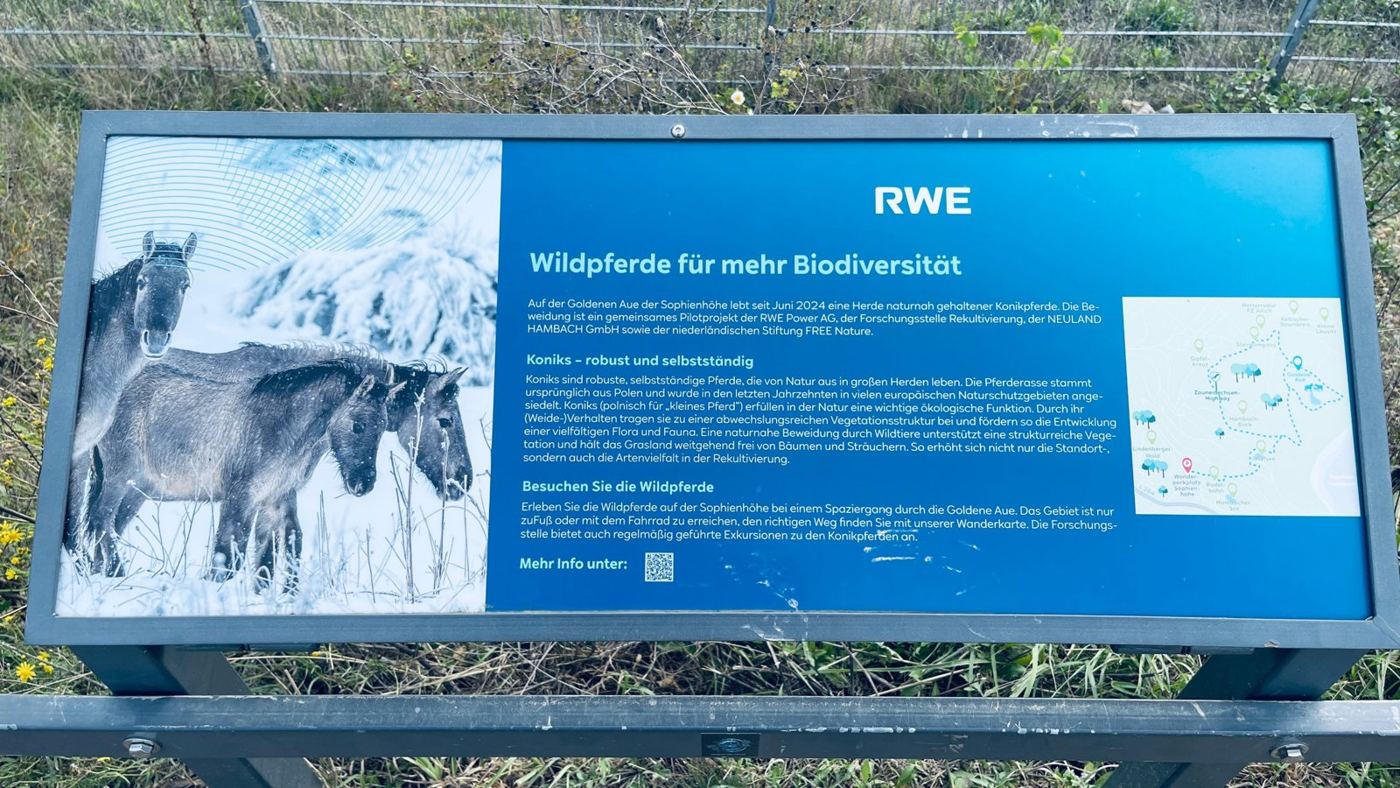
| Konik horses grazing the Sophienhöhe since June 2024 to raise biodiversity | Pilot of RWE Power, Forschungsstelle Rekultivierung, NEULAND HAMBACH and FREE Nature [1] | No monitoring baseline or results on the panel |
| (Not on any panel) | Manheimer Bucht excavation for slope material [15]. Subsidence beyond the pit edge [13] | Everything in this row |
Five things to do before the first water flows
In my own field, the EU Deforestation Regulation requires any company placing cocoa from Cameroon on the European market to supply the geolocation of the plot where it grew [31]. Germany asks less of the closure of its largest mine than Brussels asks of a smallholder’s cocoa field. Closing that gap does not need new science. It needs disclosure and independent checking.
Settle the water law permit for the lakes before 2030. Tie abstraction to a micropollutant standard that tightens at low Rhine flow, and decide on treatment on the evidence. Cost should not be the deciding objection: RWE forecasts adjusted EBITDA of up to €6.35 billion for 2026 [32].
Publish a filling schedule under the ICPR climate scenarios, as a range, and replace the ten year promise on the panel with it.
Put post mining monitoring in independent hands with open data: groundwater levels, ground motion from the European Ground Motion Service, lake chemistry, and biodiversity on the Sophienhöhe. The KVBG already requires independent expert bodies, including the Expertenrat für Klimafragen, to assess the federal coal reviews [19]. The water and ground data deserve the same.
Decide the coal reserve together with its rules: dispatch criteria, who pays, and an emissions cap.
Sign the Hambach Forest contract by 31 December 2026 as promised, and publish the slope material balance for the Manheimer Bucht so the public can see whether every hectare dug is needed.
The view from the rim
Standing on the concrete bench at the viewpoint, it is easy to read Hambach as a story that ends in 2029. The excavator on the far bench says otherwise. The coal will stop. The water, the ground and the bill will keep moving for another forty years. The child whose wagon stood beside the deckchairs will be middle aged before the lake is full.
Germany chose to close this mine. It has not yet chosen how carefully. That choice is being made now, in a delayed federal report, an unsigned forest contract and an unsettled water permit, and it should be made on data the public can see.
Kisife Jude is an environmental intelligence specialist and the founder of SustainIt.ai, a consultancy working on forest monitoring and EU deforestation compliance in Europe and Central Africa. He holds master’s degrees from the University of Copenhagen and TU Dresden.
Competing interests: The author has no financial relationship with RWE, BUND or any other party named in this article.
Photographs: Elena Schumacher. All photographs taken at Forum: terra nova, Elsdorf, 10 October 2026.
References
[1] RWE Power AG and :terra nova (Städte Bedburg, Bergheim, Elsdorf; Rhein Erft Kreis). Information panels at Forum: terra nova viewpoint, Elsdorf. Photographed by Elena Schumacher, 10 October 2026.
[2] RWE AG. Water management in lignite mining. Accessed 14 October 2026. https://www.rwe.com/en/the group/countries and locations/water management/
[3] Bezirksregierung Arnsberg (2026). Rahmenbetriebsplan für den Bau und Betrieb der Rheinwassertransportleitung zugelassen. Press release, 29 January 2026. https://www.bra.nrw.de/presse/rahmenbetriebsplan fuer den bau und betrieb der rheinwassertransportleitung zugelassen
[4] RWE Power AG (2026). Spatenstich für die Rheinwassertransportleitung: Startschuss für das Rheinische Seenland. Press release, 17 March 2026. https://www.rwe.com/presse/rwe power/2026-03-17 spatenstich fuer die rheinwassertransportleitung/
[5] Dr. Web Magazin (2026). Rheinwassertransportleitung: Grundstein für das Pumpwerk in Dormagen. July 2026. https://www.drweb.de/rheinwassertransportleitung rwe pumpwerk dormagen/
[6] taz (2026). RWE startet Leitungsbau für das „Rheinische Seenland“. 17 March 2026. https://taz.de/!s=Hambacher+Forst/
[7] Schultze, M., Pokrandt, K.-H., & Hille, W. (2010). Pit lakes of the Central German lignite mining district: creation, morphometry and water quality aspects. Limnologica, 40(2), 148-155.
[8] International Commission for the Protection of the Rhine (ICPR) (2024). Climate change induced discharge scenarios for the Rhine basin. Technical Report No. 297. Lead author E. Nilson (Bundesanstalt für Gewässerkunde). https://www.iksr.org/fileadmin/user_upload/DKDM/Dokumente/Fachberichte/EN/rp_En_0297.pdf
[9] energiezukunft (2025). Wasserentnahme aus dem Rhein: Eine bergrechtliche Pflicht, für die RWE zahlen muss. 29 October 2025. https://www.energiezukunft.eu/umweltschutz/wasserentnahme aus dem rhein eine bergrechtliche pflicht fuer die rwe zahlen muss
[10] Albergamo, V., Schollée, J. E., Schymanski, E. L., Helmus, R., Timmer, H., Hollender, J., & de Voogt, P. (2019). Nontarget screening reveals time trends of polar micropollutants in a riverbank filtration system. Environmental Science & Technology, 53(13), 7584-7594. https://doi.org/10.1021/acs.est.9b01750
[11] CORRECTIV (2026). Chemiecocktail aus dem Rhein könnte in Bergbauseen landen. 13 February 2026. https://correctiv.org/aktuelles/kampf um wasser/2026/02/13/chemiecocktail aus dem rhein koennte in bergbauseen landen/
[12] Tichys Einblick (2026). RWE pumpt künftig Rheinwasser in die Tagebaue. July 2026. https://www.tichyseinblick.de/daili es sentials/rwe dormagen baubeginn nerobefehl/
[13] Ritushree, D. K., Baes, M., & Motagh, M. (2026). Hydrological and tectonic linkage to subsidence risk in the Rhineland coalfields, Germany: integrating machine learning with remote sensing and geospatial data. Engineering Geology, 369, 108751. https://doi.org/10.1016/j.enggeo.2026.108751
[14] Moraiti, E., Christaras, B., & Brauer, R. (2010). Landslide in Nachterstedt of Germany. Bulletin of the Geological Society of Greece, 43, 1267-1271. https://ejournals.epublishing.ekt.gr/index.php/geosociety/article/view/11303
[15] BUND NRW (2025). Tagebau Hambach: RWE rodet wieder. BUND NRW Magazin, 01/25. https://e pflicht.ulb.hhu.de/download/pdf/427635
[16] epd / evangelisch.de (2025). Oberverwaltungsgericht erlaubt RWE Rodung des Sündenwäldchens. 28 January 2025. https://www.evangelisch.de/inhalte/238745/28-01-2025/oberverwaltungsgericht erlaubt rwe rodung des suendenwaeldchens
[17] energiezukunft (2019). Von den 10 größten Klimasündern kommen 7 aus Deutschland (EU ETS verified emissions 2018). https://www.energiezukunft.eu/klimakrise/von den 10 groessten klimasuendern kommen 7 aus deutschland
[18] Cleanthinking (2026). Braunkohleausstieg 2030: Der Streit um drei Blöcke, die keiner mehr will. 7 August 2026. https://www.cleanthinking.de/braunkohleausstieg 2030 reserve debatte 2/
[19] Kohleverstromungsbeendigungsgesetz (KVBG), § 47 and § 54. Federal Ministry of Justice. https://www.gesetze im internet.de/kvbg/__47.html
[20] Deutscher Bundestag (2022). Drucksache 20/4300: Gesetzentwurf zur Beschleunigung des Braunkohleausstiegs im Rheinischen Revier. 8 November 2022. https://dserver.bundestag.de/btd/20/043/2004300.pdf
[21] dpa AFX (2026). Wirtschaftsministerium: Kohleausstiegs Bericht kommt später. August 2026. https://www.boerse online.de/dpa afx/wirtschaftsministerium kohleausstiegs bericht kommt spaeter 544290.html
[22] dpa via cash.ch (2026). RWE plant weiter Kohleausstieg 2030, Reservebetrieb möglich. 13 August 2026. https://www.cash.ch/news/rwe plant weiter kohleausstieg 2030 reservebetrieb moglich 960829
[23] dpa, reporting Statistisches Bundesamt (Destatis) (2026). Preise für Strom und Gas sinken auf hohem Niveau leicht. 30 September 2026. https://www.infranken.de/deutschland/preise fuer strom und gas sinken auf hohem niveau leicht art 6399635,PRINT
[24] dpa via cash.ch (2026). Deutsches Wirtschaftsministerium: Kohleausstiegs Bericht kommt später. August 2026. https://www.cash.ch/news/deutsches wirtschaftsministerium kohleausstiegs bericht kommt spater 960200
[25] dpa via Die Rheinpfalz. Bericht: Auch bei früherem Kohleausstieg Stromversorgung sicher (Bundesnetzagentur supply security monitoring report). https://www.rheinpfalz.de/lokal/pfalz ticker_artikel,-bericht auch bei fr%C3%BCherem kohleausstieg stromversorgung sicher-_arid,5462393.html
[26] Wirtz Amling, M. (2024). Tagebau Hambach (KLV BK Rheinland 018). KuLaDig, Landschaftsverband Rheinland. https://www.kuladig.de/Objektansicht/Drucken/SWB 356316
[27] energiezukunft. Hambacher Forst: Der Forst ist ein Wald. https://www.energiezukunft.eu/umweltschutz/der forst ist ein wald
[28] Land Nordrhein Westfalen (2026). Dauerhafter Schutz für den Hambacher Wald: Breite Allianz unterzeichnet Erklärung. Press release and joint declaration, 9 June 2026. https://www.land.nrw/pressemitteilung/dauerhafter schutz fuer den hambacher wald breite allianz unterzeichnet erklaerung
[29] Cleanthinking (2026). Hambacher Forst: Aus dem Protestwald wird Urwald. June 2026. https://www.cleanthinking.de/?p=1069744
[30] dpa AFX (2026). Braunkohlerevier: BUND scheitert vor Gericht im Streit um Hambach Grundstück. 24 July 2026. https://extraetf.com/de/news/dpa afx/braunkohlerevier bund scheitert vor gericht im streit um hambach grundstuck--1784902879-06022-1784902876959
[31] Regulation (EU) 2023/1115 of the European Parliament and of the Council on deforestation free products (EU Deforestation Regulation), Article 9. https://eur lex.europa.eu/eli/reg/2023/1115/oj
[32] Dr. Web Magazin (2026). RWE Kohleausstieg 2030: Reserve und Bund, citing RWE half year report, 13 August 2026. https://www.drweb.de/rwe kohleausstieg 2030 reserve bund/